Press
[BioTimes] CARM Calls for Greater Investment in Bi
[BioTimes] CARM Calls for Greater Investment in Biotech Companies at Open Innovation Investment Conference
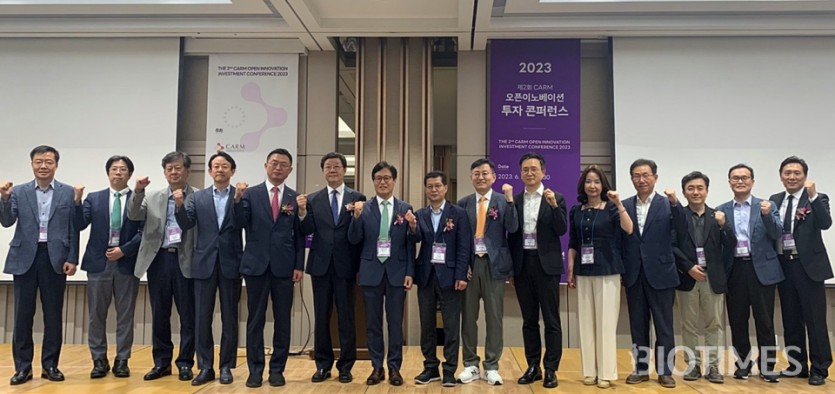
Representatives from participating companies, investment firms, and related organizations at the 2nd CARM Open Innovation Investment Conference
Event Held to Promote the Advanced Regenerative Bio Industry and Support Investment in Promising Companies
Co-hosted by the Korea Regenerative Medicine Fund
Supported by the Korea Venture Capital Association, Korea Investment Partners, and Daily Partners
IR Presentations by 16 Regenerative Medicine Companies with Q&A and Advisory Sessions Involving Approximately 55 Investment Firms
[BioTimes] The 2nd CARM Open Innovation Investment Conference, jointly hosted by the Council for Advanced Regenerative Medicine (CARM) and the Korea Regenerative Medicine Fund (KFRM), was held on the 21st at Hall E on the third floor of COEX in Samseong-dong, Gangnam-gu, Seoul.
Now in its second year, the event was organized to help revitalize investment sentiment at a time when funding for biotech companies has become increasingly constrained.
Designed to promote Korea’s advanced regenerative biotechnology industry and support promising companies in attracting investment, the conference was supported by the Korea Venture Capital Association, Korea Investment Partners, and Daily Partners.
Attendees included Kang Kyung-sun, Chairman of CARM; Eun Seong-ho, Director General for Advanced Medical Support at the Ministry of Health and Welfare; Cho In-ho, Head of the Korea Regenerative Medicine Fund; Noh Yeon-hong, Chairman of the Korea Pharmaceutical and Bio-Pharma Manufacturers Association; Hwang Man-soon, CEO of Korea Investment Partners; and Yoon Keon-soo, Chairman of the Korea Venture Capital Association.
In his welcoming remarks, Chairman Kang said he hoped the conference would provide a meaningful opportunity to discuss investment in pharmaceutical and biotechnology companies during a difficult funding environment both in Korea and abroad.
He added that rising interest in health and longevity, particularly among the baby boomer generation, is expected to drive explosive growth in related industries. As a result, he said, the pharmaceutical and biotechnology sectors are likely to become core industries of the future. He emphasized that if investors take greater interest in advanced regenerative medicine, companies will be better positioned to deliver tangible products and meaningful results.
In his congratulatory remarks, Hwang Man-soon, CEO of Korea Investment Partners, noted that one reason investment in unlisted and early-stage biotech companies has yet to recover is the weak performance of listed biotech stocks.
He also suggested that growth industries such as biotechnology could benefit from restrictions on short selling. Hwang noted that many biotech companies had previously gone public through technology-based listing programs and expressed appreciation for recent efforts by the Korea Exchange to facilitate listings for biotech companies. He added that industry participants should work together with a stronger sense of solidarity to overcome the current downturn.
The conference opened with a keynote presentation by Yoon Keon-soo, Chairman of the Korea Venture Capital Association, who discussed how investor perspectives are changing along with the broader biotech market.
Yoon said Korea’s biotech market appeared to be expanding rapidly in 2020, when 17 biotech companies were listed through special technology-based IPO programs. However, by the first half of 2023, conditions had deteriorated to the point where virtually no new investments were being made, with activity largely limited to follow-on funding. He also noted that the amount of capital waiting to be deployed remained limited.
According to Yoon, stronger share prices among listed biotech companies and improved technological competitiveness among biotech ventures will both be necessary for the market to recover.
He added that the current difficulties facing biotech companies could also create opportunities for a new phase of growth. The fact that 15 of the top 50 companies by market capitalization on KOSDAQ were biotech firms, he said, represents a significant achievement that should be communicated more effectively to encourage additional investment and listings.
Yoon also emphasized that although drug development remains a slow process, meaningful progress continues to be made. With the market for biotechnology expected to expand further in an aging society, he encouraged companies to use the current period to strengthen their fundamentals.
He further noted that investors once preferred companies with a broad range of pipelines, but now tend to favor businesses that select a smaller number of high-impact programs and focus resources on them. He stressed that global competitiveness is essential and that companies should actively embrace emerging technologies, including AI, rather than remain tied to conventional approaches.
Following the keynote presentation, 16 regenerative medicine companies delivered investor relations presentations, followed by Q&A and advisory sessions involving approximately 55 domestic investment firms. One-on-one meetings between investors and CARM member companies were also held after the IR sessions.
The 16 participating companies were NeurolMed, Maru Therapeutics, MarkHelz, B-Element, StemExOne, Acrocell Bioscience, Xcell Therapeutics, Youth Bio Global, InstemCare, ILIAS Biologics, GeneMedicine, CLIPS BnC, PAIAN Biotechnology, Pentamedix, Primoris Therapeutics, and HaplScience.
CARM said it hopes the event will help restore weakened investment sentiment in the pharmaceutical and biotechnology sectors through collaboration with relevant organizations and investors, while creating opportunities for small and venture companies to take the next step in their growth.
Founded in 2016, the Council for Advanced Regenerative Medicine (CARM) is an industry-led organization established to promote Korea’s regenerative medicine sector and strengthen the country’s position in the global regenerative medicine market.
The association has worked to secure government funding, improve regulations, and promote investment in companies active in advanced regenerative medicine. It also contributed to efforts surrounding the passage of Korea’s advanced regenerative bio legislation and to the establishment of a broader national R&D ecosystem for regenerative medicine.
CARM operates several committees, including the External Cooperation Committee, Policy Committee, and Corporate Exchange Committee. The Corporate Exchange Committee, which organized this conference, is chaired by Lee Eui-il, CEO of Xcell Therapeutics, and focuses on supporting regenerative medicine ventures and startups while promoting greater collaboration across companies and related industry sectors.
BioTimes / Reporter Kim Soo-jin
sjkimcap@biotimes.co.kr