Press
[Edaily] Which Regenerative Medicine Companies Are
[Edaily] Which Regenerative Medicine Companies Are Drawing VC Attention Amid the Biotech Investment Slowdown?
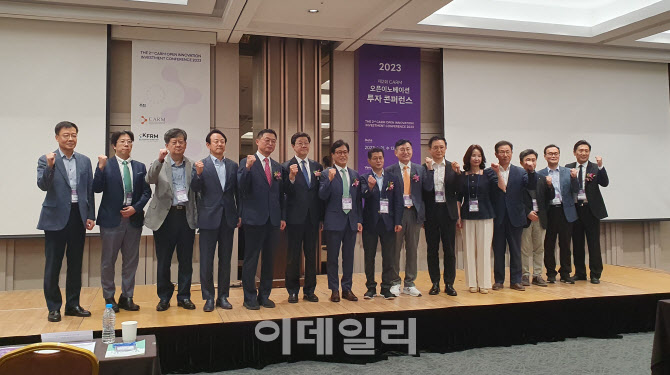
Participants pose for a commemorative photo at the 2nd CARM Open Innovation Investment Conference, hosted by the Council for Advanced Regenerative Medicine on the 21st at COEX in Gangnam-gu, Seoul.
Photo: Edaily / Reporter Kim Sae-mi
2nd CARM Open Innovation Investment Conference Held on the 21st
More Than 10 Additional Investment Firms Participated Compared with Last Year; Venue Filled to Capacity
ILIAS Biologics and GeneMedicine Draw Attention Among Participating Companies
[Edaily, Reporter Kim Sae-mi] Korea’s regenerative medicine companies and investors gathered to discuss biotech investment at a time when funding conditions across the sector remain sluggish.
The Council for Advanced Regenerative Medicine (CARM) held the 2nd CARM Open Innovation Investment Conference on the 21st at COEX in Gangnam-gu, Seoul, providing a venue where regenerative medicine companies could meet with venture capital firms.
Regenerative medicine refers to technologies designed to replace damaged cells, tissues, or organs or restore their original functions.
A total of 14 companies delivered IR presentations, while 55 investment firms participated in the event. The number of participating investors increased by more than 10 compared with last year, when around 30 firms took part.
Despite securing a venue nearly twice as large as the previous year’s, the event was filled to capacity, with some attendees standing throughout the sessions.
A CARM representative said, “Last year, 35 investment professionals applied to attend the conference, but this year the number exceeded 75. We are beginning to see signs that interest in biotech investment is recovering.”
The 16 companies participating in IR sessions and one-on-one meetings included NeurolMed, Maru Therapeutics, MarkHelz, B-Element, StemExOne, Acrocell Bioscience, Xcell Therapeutics, Youth Bio Global, InstemCare, ILIAS Biologics, GeneMedicine, CLIPS BnC, PAIAN Biotechnology, Pentamedix, Primoris Therapeutics, and HaplScience.
Among them, ILIAS Biologics and GeneMedicine attracted particular attention from investors.
ILIAS Biologics is a drug development company developing exosome-based therapeutics, an emerging next-generation modality in drug delivery.
According to Allied Market Research, the global market for exosome therapeutics and diagnostics was projected to grow from approximately USD 224 million in 2020 to USD 2.9 billion by 2030, highlighting the sector’s growth potential.
ILIAS plans to generate revenue primarily through domestic and international licensing deals. Its strategy includes independently developing candidates through early-stage clinical trials before licensing them to overseas partners, as well as jointly developing lead candidates with partners and either licensing them back to those partners or out-licensing them to third parties.
Although ILIAS reported consolidated revenue of only KRW 29.26 million last year, it currently holds one of the most advanced clinical-stage exosome therapeutic pipelines in Korea, raising expectations for potential licensing deals.
Its lead pipeline is ILB-202, a therapy for cardiac surgery-associated acute kidney injury (CSA-AKI). The company began a Phase 1 clinical trial in Australia in April and plans to complete the study as early as the end of the year before evaluating potential licensing opportunities.
ILIAS is targeting KRW 20 billion in funding by the end of this year to support its clinical development activities.
GeneMedicine, which is developing oncolytic virus gene therapies, also drew considerable investor attention.
The company is seeking to raise KRW 10 billion this year and has already secured a total of KRW 50.6 billion, including KRW 16.5 billion in May 2019 and KRW 34.1 billion in July 2021.
GeneMedicine has four oncolytic virus pipelines and also provides CDMO and CMO services specialized in viral vectors.
Under Korea’s regulatory framework for advanced regenerative medicine and advanced biopharmaceuticals, oncolytic virus therapies may qualify for conditional approval ahead of Phase 3, potentially allowing earlier market entry based on Phase 2 results.
Among GeneMedicine’s pipelines, GM101, a treatment candidate for triple-negative breast cancer, is targeting submission of a Phase 2 IND application in the fourth quarter.
At the event, Kang Kyung-sun, Chairman of CARM, said the baby boomer generation born between 1945 and 1960 would play a major role in driving the pharmaceutical and biotechnology industries as future growth sectors.
He noted that this generation has accumulated substantial wealth and is expected to account for a significant portion of Korea’s population by 2030.
“From a demographic perspective, baby boomers are a generation with both the financial capacity to spend and a strong interest in health and longevity,” Kang said. “As similar generations come to represent roughly half the population in advanced economies, the pharmaceutical and biotechnology industries are likely to experience explosive growth over the next decade.”
He added, “At a time when investment conditions remain difficult both domestically and globally, I hope this event will encourage active discussion and greater investment in pharmaceutical and biotech companies.”
The conference was jointly hosted by CARM and the Korea Regenerative Medicine Fund, organized by the CARM Corporate Exchange Committee, chaired by Lee Eui-il, CEO of Xcell Therapeutics, and supported by Korea Investment Partners, Daily Partners, and the Korea Venture Capital Association.