Press
[Bio Talk] Konkuk University Prof. Ssang-Goo Cho:
[Bio Talk] Konkuk University Prof. Ssang-Goo Cho: “Scope of Advanced Regenerative Medicine Treatments Should Be Expanded”
Interview with Prof. Ssang-Goo Cho of Konkuk University’s Department of Stem Cell and Regenerative Biotechnology
Revised Advanced Regenerative Bio Act Raises Expectations for Cell and Gene Therapy Development
“Treatment Indications Should Be Expanded Beyond Severe and Rare Diseases”
[Sisa Journal-e Reporter Choi Da-eun] “We need to prevent advanced regenerative medicine research from being driven underground. Research should expand not only into common diseases but also into preventive medicine.”
Amendments to Korea’s Act on the Safety of and Support for Advanced Regenerative Medicine and Advanced Biopharmaceuticals, commonly known as the Advanced Regenerative Bio Act, passed the National Assembly in February this year, raising expectations that Korea’s stem cell, cell therapy, and gene therapy markets will enter a new phase of growth. The revised law is primarily aimed at expanding eligibility for advanced regenerative medicine clinical research and treatment.
Previously, advanced regenerative medicine—designed to restore damaged tissues or organs—could generally be used only in treatment-oriented clinical research for patients with severe, rare, or refractory diseases for which no alternative therapies were available. The field encompasses stem cell therapies, cell therapies, gene therapies, and artificial organs.
Because Korea’s advanced regenerative medicine market has traditionally been highly conservative, an estimated 10,000 to 20,000 patients each year have traveled abroad for treatments such as arthritis and immunotherapy, while concerns have also persisted over the growth of unregulated procedures.
The revised law significantly eased some of these restrictions. Patients who are not enrolled as research participants may now gain access to regenerative medicine services, and access has been broadened in particular for those with severe, rare, and refractory diseases.
However, limiting treatment eligibility primarily to severe, rare, and refractory diseases is still seen as a constraint on industry growth. Prof. Ssang-Goo Cho of Konkuk University’s Department of Stem Cell and Regenerative Biotechnology expressed disappointment, saying, “The revision should have gone much further.”
If commercialization is effectively limited to treatments for rare and refractory diseases, companies face challenges in generating sustainable returns because the eligible patient population remains small. In other words, restricting advanced regenerative medicine to these indications makes it difficult for the market to expand at scale.
Prof. Cho joined Konkuk University in 2003 as a faculty member in the Department of Animal Life Science and has since dedicated himself to stem cell therapeutics research and the training of specialized researchers. He was also a key member behind the establishment of Konkuk University’s Department of Stem Cell and Regenerative Biotechnology.
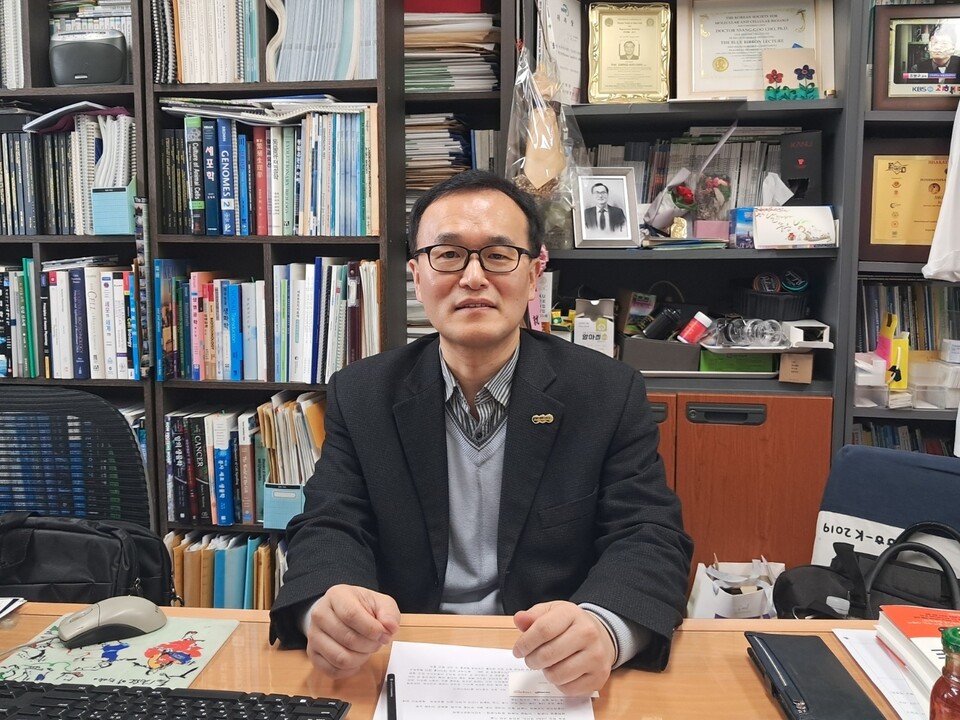
On the 27th, Prof. Ssang-Goo Cho of Konkuk University’s Department of Stem Cell and Regenerative Biotechnology sat down with Sisa Journal-e for an interview. / Photo by Choi Da-eun
The following is an edited Q&A with Prof. Cho.
What are the shortcomings of the revised Advanced Regenerative Bio Act?
The scope of treatments covered by the law should be expanded. If advanced regenerative medicine is limited only to severe, rare, and refractory diseases, it will be difficult for the industry to grow. Stem cells, in particular, have considerable potential in preventive medicine. If they are used only for patients with severe or rare diseases, the therapeutic impact may not always be dramatic.
Above all, preventing contamination is critical in regenerative medicine. We should no longer allow this field to develop in unregulated settings. Cells need to be cultured in high-quality, well-controlled facilities where contamination risks can be minimized. Bringing research and treatment into a regulated environment can reduce microbial contamination and, in turn, lower the risk of adverse effects. The scope should be broadened to include more common diseases, while preventive applications should also allow healthier individuals or those with milder conditions to participate in clinical research.
What are the advantages of stem cell, cell, and gene therapies?
Because they make use of cells and genes derived from the human body, they can offer strong therapeutic potential and a favorable biological compatibility profile. In stem cell therapy, therapeutic genes can be introduced into stem cells to enhance their differentiation and regenerative capacity, thereby improving treatment efficacy.
More recently, technologies that further enhance stem cell function, including approaches using exosomes, have also emerged.
Why is development of cell and gene therapies increasing?
If development succeeds and the resulting therapy demonstrates clear efficacy, it can potentially secure a dominant position in its target market. Cell and gene therapy technologies are becoming increasingly sophisticated, and more research is focused on developing cells with enhanced therapeutic performance.
Advances in gene-editing technologies are also enabling the development of high-performance cell therapies. As a result, the sector is increasingly viewed as a high-risk, high-return field.
At present, autologous cell and gene therapies still account for a large share of development because of safety considerations. Over time, however, I believe allogeneic therapies using cells obtained from healthy donors will become increasingly important.
How competitive is Korea in stem cell and cell therapy technologies?
Several stem cell therapeutics have already been developed globally, and Korean companies developed some of the world’s earliest commercially approved stem cell therapies.
Korea’s technology has continued to advance, and I would assess the overall level as relatively high. In some areas, we have reached roughly 80% of the level of leading countries. From a purely technological standpoint, Korean companies have sufficient capabilities to compete with global players.
Why has the domestic market remained relatively small despite this technological capability?
Regulatory authorities bear significant responsibility when approving new drugs, which has contributed to a conservative approach toward advanced regenerative medicines.
Korea’s domestic market is relatively small, while obtaining regulatory approval has also been difficult, making it harder for more progressive research to advance. From the regulator’s perspective, approving a product that later causes safety issues creates a substantial burden, so authorities have tended to take a cautious approach.
Restrictions on eligible indications have also limited the research environment compared with markets overseas.
What are the limitations of cell and gene therapy research in Korea?
Much of Korea’s cell and gene therapy research is led by biotech ventures. Many of these companies do not have sufficient financial resources to complete full clinical development programs, so promising projects may be discontinued before reaching the end of human trials.
No matter how strong the technology is, limited funding can make it difficult to carry a program through clinical development. As a result, Korean companies may accumulate less development experience than their overseas competitors.
I believe an efficient model would be for biotech ventures to focus on nurturing core technologies, while larger companies take the lead in clinical development, commercialization, and sales. Beyond simple technology licensing, joint development with financially stronger corporations will be important.
In the stem cell therapy field, relying on a single pipeline is highly risky. Ideally, companies should develop multiple pipelines simultaneously, but in reality, research funding remains a major constraint.
What are the challenges in developing talent in stem cell, cell, and gene therapy fields?
Securing highly trained talent is essential if the industry is to advance. In biotechnology, it generally takes at least five to ten years of education and training, including undergraduate study, before researchers can make meaningful contributions in industry.
For a resource-limited country like Korea, biotechnology is a particularly important high-value-added industry. We first need to encourage more university students to pursue graduate education.
Because the pharmaceutical and biotech industries typically require at least master’s-level expertise, we also need to nurture more young Ph.D.-level professionals. Greater support for graduate students and stronger backing from industry will be necessary.
What research areas are you currently most interested in?
As human life expectancy increases, demand is shifting from simply living longer to improving quality of life.
Neuropathic pain remains an area with significant unmet medical need. In many cases, treatment is still largely limited to painkillers rather than addressing the underlying cause.
Stem cells possess immunomodulatory, regenerative, and homing capabilities. When activated in the body, they may help regulate immune responses and promote regeneration of neural tissues, potentially offering new approaches to pain-related disorders.
We are currently studying stem cell-based therapies for conditions in which the underlying mechanisms remain difficult to define, including bladder pain syndrome, neurological disorders, dementia, and Parkinson’s disease. These programs are currently at the animal-study stage.
© Sisa Journal-e. Unauthorized reproduction and redistribution prohibited.