Press
[Sisa Journal-e] Cell Therapies Emerge as a Game C
[Sisa Journal-e] Cell Therapies Emerge as a Game Changer as Major Corporations Accelerate Entry
Personalized Medicine Era Drives Growing Interest in CGT
Korean Pharmaceutical Companies Expand Development of Related Technologies
Major Corporate Investment and Regulatory Reforms Boost Momentum
“CGT Pipeline Development Expected to Accelerate”
[Sisa Journal-e Reporter Choi Da-eun] Research and development (R&D) in cell and gene therapies (CGTs) is expanding as major Korean pharmaceutical companies move into the emerging market for next-generation therapeutics. Expectations are growing that the financial resources of large corporations will further accelerate clinical research in the field.
According to industry sources on the 28th, the CGT sector—previously driven largely by biotech ventures conducting clinical research—is now attracting a broader range of pharmaceutical companies, including Samsung, which have announced plans to enter the market.
Momentum has also been strengthened by the recent passage of amendments to Korea’s Advanced Regenerative Bio Act, which eased certain regulatory requirements. Industry observers expect the changes to accelerate R&D and pipeline development across the cell and gene therapy sector.
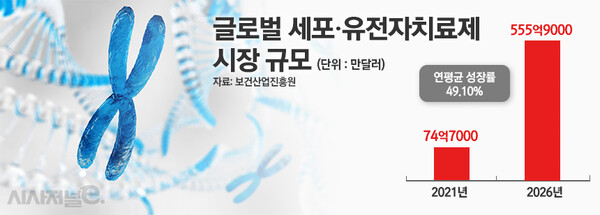
Global Cell and Gene Therapy Market Size. / Graphic by Designer Seung-A Jung
Cell and gene therapies (CGTs) are medicinal products that use cells, genes, or a combination of both to treat or prevent disease. They are primarily being developed for genetic disorders, cancer, and certain chronic diseases. Stem cell therapies, CAR-T therapies, and NK cell therapies are among the best-known examples.
According to the Korea Health Industry Development Institute (KHIDI), the global CGT market is projected to grow from USD 7.47 billion in 2021 to USD 55.59 billion in 2026, representing a compound annual growth rate of 49.1%.
In Korea, regulatory barriers were significantly eased this month following the passage of amendments to the Advanced Regenerative Bio Act by the National Assembly. Under the revised law, patients who are not enrolled as research participants may also receive regenerative medicine treatments.
In particular, access to advanced regenerative medicine has been expanded for patients with severe, rare, and refractory diseases. Even treatments that have not yet received full regulatory approval may be administered if their safety and efficacy have been demonstrated through clinical research.
As broader access to stem cell and gene therapies is expected to benefit Korea’s biotechnology industry, companies are accelerating efforts to secure relevant pipelines. Domestic pharmaceutical companies are increasingly focusing on technology development to gain an early foothold in the CGT market.
Dong-A ST and SK Biopharmaceuticals have both identified cell and gene therapies as next-generation strategic growth areas and announced plans to expand their advanced therapeutics businesses.
Last month, Dong-A ST signed a memorandum of understanding with Israel-based Eleven Therapeutics to develop RNA-based gene therapies. The companies plan to conduct joint research to discover RNA therapeutics targeting fibrotic diseases using Eleven Therapeutics’ proprietary TERA platform.
SK Biopharmaceuticals has also named cell and gene therapies as a new growth engine and outlined plans to accelerate R&D by leveraging synergies across the SK Group.
JW Shinyak, meanwhile, is preparing to develop anticancer cell therapies by establishing an in-house R&D platform in collaboration with C&C Research Laboratories, a subsidiary of JW Pharmaceutical. The companies plan to develop novel CAR-NK cell therapies targeting solid tumors, with the additional goal of establishing a gene-engineering-based CAR-NK R&D platform.
Chong Kun Dang has also moved to strengthen its capabilities in cell and gene therapy development. In 2022, the company signed a joint research agreement and made a strategic investment in ENCell to leverage its expertise in CGT development.
Samsung, through its biotechnology affiliates, has also decided to invest in U.S. biotech companies developing gene therapies. Seeking synergies among its affiliates, the group is focusing particularly on gene therapy within the broader CGT sector as a next-generation growth engine. As gene therapies account for a growing share of new drug development, Samsung aims to establish an early position in the field.
Korea’s cell and gene therapy industry has traditionally been regarded as a field where commercialization remained difficult despite strong technological capabilities because of regulatory constraints. Since many therapies rely on a patient’s own cells or genes, development costs are high, while regulatory hurdles have also been substantial, making it difficult for biotech ventures to independently complete the entire clinical development cycle.
However, as demand for personalized medicine continues to rise, the market for therapies based on individual genetic and cellular profiles is expanding rapidly.
Prof. Ssang-Goo Cho of Konkuk University’s Department of Stem Cell and Regenerative Biotechnology said, “Cell and gene therapies are classified as part of the advanced biotechnology industry, and the scope of R&D is expanding rapidly alongside technological advances. In Korea, however, development has progressed relatively slowly because regulatory authorities have placed a strong emphasis on safety.”
He added, “With the passage of the revised Advanced Regenerative Bio Act, patients with rare and refractory diseases are expected to have greater access to cell and gene therapies than before. This should also provide valuable opportunities to accumulate safety and efficacy data for new therapeutics.”
Prof. Cho also noted, “Until now, CGT pipeline development in Korea has largely been driven by biotech ventures, but many of these companies have had to discontinue programs because of limited financial resources.”
“More recently, however, major corporations and traditional pharmaceutical companies have shown growing interest in CGT pipelines, leading to increased strategic and financial investment. This is creating an opportunity to reduce R&D uncertainty caused by the high cost of development,” he said.