Press
[Smart Economy] Prof. Ssang-Goo Cho’s Team at Konk
[Smart Economy] Prof. Ssang-Goo Cho’s Team at Konkuk University Uses AI to Predict 3D Protein Structures
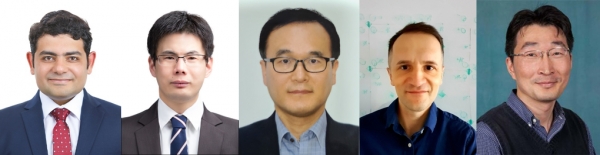
Prof. Ssang-Goo Cho of Konkuk University (third from left), Dr. Ahmed Abdal Dayem of Konkuk University, Ph.D. candidate Soo Bin Lee, Prof. Sebastian Kmiecik of the University of Warsaw, and Prof. Deok-Ho Kim of Johns Hopkins University. (Photo courtesy of Konkuk University)
[Smart Economy Reporter Bok Hyun-myung] A research team led by Prof. Ssang-Goo Cho of the Department of Stem Cell and Regenerative Biotechnology at Konkuk University’s KU Institute of Science and Technology has developed a fibroblast growth factor-2 (FGF-2)-derived peptide that enhances stem cell growth and improves therapeutic efficacy for osteoarthritis by using an AI-based model that predicts three-dimensional protein structures.
The findings were published in the Journal of Advanced Research (Impact Factor 10.7) and were also featured in the Biological Research Information Center’s “Korean Scientists Who Shine” program.
The study was conducted in collaboration with researchers in Poland and the United States, as well as industry partners including AMO LifeScience and StemExOne.
Prof. Cho’s team cultured human Wharton’s jelly-derived mesenchymal stem cells (hWJ-MSCs) using an FGF-2-derived peptide (FP2) conjugated with a mussel-derived adhesive protein supplied by AMO LifeScience. The researchers confirmed that the resulting cells showed therapeutic effects in alleviating symptoms of osteoarthritis.
FGF-2 plays a critical role in regulating diverse cellular functions across tissues and organs, including embryonic development and wound healing.
It is also important for maintaining the self-renewal capacity and multipotency of stem cells. However, because FGF-2 is relatively unstable, it must be added repeatedly during cell culture, increasing production costs.
To overcome this limitation, the research team used the more stable FP2 peptide as an alternative to FGF-2 to culture functionally enhanced stem cells and subsequently confirmed improved therapeutic efficacy in a mouse model of osteoarthritis.
To investigate the structure and function of the FP2 peptide, whose biological mechanism had not been fully characterized, the team collaborated with Dr. Sebastian Kmiecik of the University of Warsaw. Using AI-based computational methods, the researchers analyzed the binding affinity between FP2 and fibroblast growth factor receptor-1 (FGFR-1) and confirmed strong and stable molecular interactions.
The study was supported by the Korea Regenerative Medicine Fund (KFRM) and the National Research Foundation of Korea (NRF).
StemExOne, a subsidiary of Konkuk University Holdings led by CEO Ssang-Goo Cho, signed an MOU with AMO LifeScience in June to pursue joint stem cell research, with this study representing the first research outcome from the collaboration.
StemExOne has also recently secured an investment from SYS Holdings, the operator of ETLAND.
Building on this investment, the company plans to advance the development of various exosome-based therapeutics for refractory inflammatory diseases, sepsis, and osteoarthritis, as well as functional cosmetics and pharmaceutical ingredients, while pursuing expansion into global markets.
Reporter Bok Hyun-myung
hmbok@dailysmart.co.kr
Source: Smart Economy