Press
Konkuk University Research Team Explores Stem Cell
Konkuk University Research Team Explores Stem Cell-Based Treatment for Lacrimal Gland Disorders
Joint Research by Prof. Ssang-Goo Cho’s Team at the Division of Advanced Bioengineering and Prof. Hyun-Jin Shin’s Team at Konkuk University Medical Center
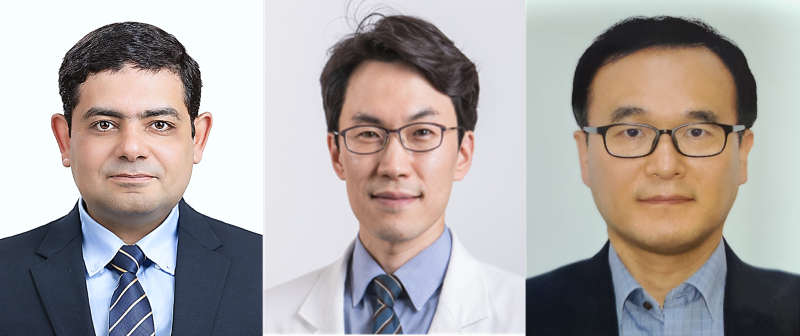
From left: Prof. Ahmed Morsy of Konkuk University, Prof. Hyun-Jin Shin of the Department of Ophthalmology at Konkuk University Medical Center, and Prof. Ssang-Goo Cho of Konkuk University, CEO of StemExOne.
A research team led by Prof. Ssang-Goo Cho of the Department of Stem Cell and Regenerative Biotechnology, Division of Advanced Bioengineering at Konkuk University, has published a review article in collaboration with Prof. Hyun-Jin Shin of the Department of Ophthalmology at Konkuk University Medical Center and StemExOne. The study, conducted through an integrated university-hospital-industry collaboration, reviews recent advances in lacrimal gland (LG) organoid technology and its potential therapeutic applications.
The article was published in February in Biomedicine & Pharmacotherapy, an international journal ranked within the top 5% in pharmacology and pharmacy.
Titled “Advances in Lacrimal Gland Organoid Development: Techniques and Therapeutic Applications,” the review provides a comprehensive overview of how recent stem cell-based lacrimal gland organoid research could be applied to the treatment of disorders caused by lacrimal gland dysfunction, including dry eye disease (DED).
The researchers highlighted the potential of lacrimal gland organoids derived from human induced pluripotent stem cells (hiPSCs) to enable personalized therapies and regenerative medicine approaches that differ fundamentally from conventional cell- or drug-based treatments.
Lacrimal gland organoids can closely recapitulate the physiological characteristics of native lacrimal tissue and offer a wide range of potential clinical applications, including disease modeling, drug screening, personalized treatment development, and tissue regeneration using organoid-derived extracellular vesicles (OEVs).
The review also outlines the roles of key biological signaling pathways involved in lacrimal gland development and organoid formation, including fibroblast growth factor (FGF) and Notch signaling. For future research, the authors propose strategies to improve organoid functionality through technologies such as assembloids, microfluidic chips, organ-on-a-chip systems, and synthetic biomaterials.