Press
[Veritas Alpha] Konkuk University Prof. Ssang-Goo
[Veritas Alpha] Konkuk University Prof. Ssang-Goo Cho’s Team Demonstrates Potential of Stem Cell-Derived Exosomes for Treating Obstructive Sialadenitis
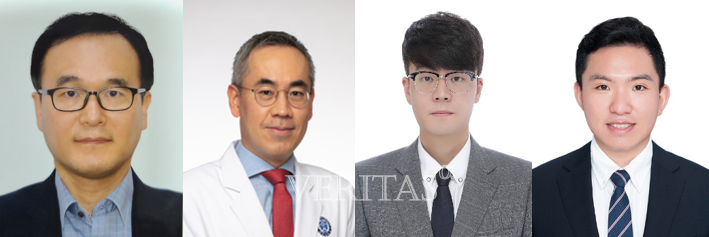
Joint research team from Konkuk University and Gangnam Severance Hospital, Yonsei University. From left: Prof. Ssang-Goo Cho, Prof. Jae-Yeol Lim, Dr. Kyung Min Lim, and Research Prof. Dong-Hyun Kim.
Photo courtesy of Konkuk University
[Veritas Alpha, Reporter Park Won-seok] Konkuk University announced on the 12th that a research team led by Prof. Ssang-Goo Cho of the KU Institute of Science and Technology and Department of Stem Cell and Regenerative Biotechnology, in collaboration with Prof. Jae-Yeol Lim’s team at Gangnam Severance Hospital, Yonsei University, and the StemExOne R&D team, has demonstrated the potential of stem cell-derived exosomes for treating obstructive sialadenitis.
Obstructive sialadenitis is an inflammatory condition of the salivary glands caused when the flow of saliva is blocked or delayed by calcified deposits such as salivary stones. It frequently occurs together with chronic sialadenitis, and reduced salivary gland function can lead to difficulty speaking, impaired digestion, and limitations in daily activities, significantly affecting quality of life.
Although various studies have sought to restore impaired salivary gland function, current treatment options remain largely limited to medications such as pilocarpine, which stimulates saliva secretion, oral agents that relieve dry mouth, and in severe cases, surgical removal of the salivary gland through an incision in the neck.
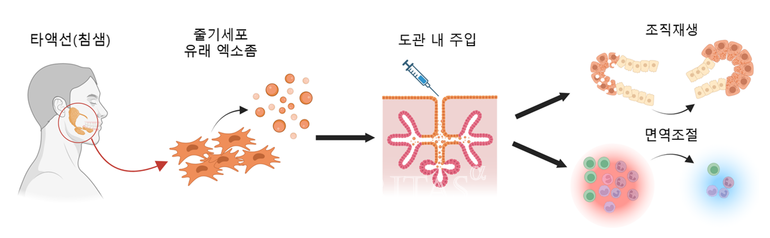
To explore a regenerative treatment approach, the joint research team isolated exosomes from salivary gland-derived stem cells and applied them to three-dimensional salivary gland organoids that preserve key glandular functions, as well as to a mouse disease model.
Salivary gland-derived stem cells showed characteristics comparable to umbilical cord tissue-derived stem cells and, in some respects, advantages over adipose tissue-derived stem cells, which are commonly used as a source of mesenchymal stem cells.
According to the findings, exosomes secreted by salivary gland-derived stem cells demonstrated a higher uptake rate in salivary gland epithelial cells than exosomes derived from umbilical cord stem cells.
In the organoid model, the exosomes restored expression of aquaporin-5 (AQP5), a key water-channel protein whose expression had been reduced by inflammation, to near-normal levels. In the mouse model, they also demonstrated the ability to promote salivary gland tissue regeneration and regulate immune cell infiltration.
Prof. Cho said, “Stem cell-derived exosomes are attracting significant attention because of their excellent biocompatibility and therapeutic potential across a wide range of diseases. These findings further demonstrate the broad potential of stem cell exosomes, and continued interest and support for translational research will be essential to advance the technology toward clinical application.”
Prof. Lim said, “Stem cell-derived exosomes could be effectively combined with salivary gland endoscopy, potentially reducing the adverse effects associated with conventional drug therapy and surgery. We expect this approach to contribute significantly to improving quality of life for many patients in an aging society.”
The findings were published in the Journal of Controlled Release (Impact Factor 11.467), an internationally recognized journal ranked within the top 5% in the pharmaceutical sciences, and were also featured in the Biological Research Information Center’s “Korean Scientists Who Shine” program.
The paper’s co-first authors were Dr. Kyung Min Lim of Konkuk University and Research Prof. Dong-Hyun Kim of Gangnam Severance Hospital, Yonsei University, while Prof. Ssang-Goo Cho and Prof. Jae-Yeol Lim served as corresponding authors.
StemExOne, which is participating in multiple government-funded projects related to the development of stem cell exosome therapeutics, including the Korea Regenerative Medicine Fund (KFRM) and TIPS, also participated in the study and plans to continue efforts toward therapeutic development and commercialization.
Copyright © Veritas Alpha. Unauthorized reproduction and redistribution prohibited.